

Table of Contents
- What Makes a Premium Rum Genuinely Sugar-Free?
- How to Tell If Rum Has Added Sugar: A Practical Checklist
- Rum Brands with No Added Sugar: What to Look For
- 1. Solar Reserve 55: Best Sugar-Free Premium Rum for Cocktails
- 2. Solar Reserve 8: Best Sugar-Free Rum for Sipping Neat
- 3. Solar Reserve Discovery Duo: Best Sugar-Free Rum Gift Set
- Sugar-Free Rum for Cocktails: Daiquiris, Old Fashioneds and More
- Conclusion: Choosing the Right Sugar-Free Premium Rum for You
- Frequently Asked Questions
Last Updated: October 5, 2026
What Makes a Premium Rum Genuinely Sugar-Free?
Sugar-free rum is a spirit with no sugar added after distillation, which means the only sugars present are those naturally created during fermentation.
At SolarRum, we bottle Caribbean rum without added sugar, and we have watched the sugar-free claim become one of the least regulated and most misunderstood terms on the shelf.
The best sugar free premium rum brands share three traits: transparent production, an age statement you can verify, and a flavour profile built by the barrel rather than the blender's spoon. Below, we break down how to spot the difference.
The difference between sugar-free and unsweetened rum
Sugar-free rum contains no sugar added at any point after distillation. Unsweetened rum is a looser term that some producers use to describe a spirit with minimal dosing, but it does not guarantee zero.
The distinction is not academic. A rum labelled unsweetened may still carry a small amount of added sugar that falls below a producer's own threshold. Sugar-free, used strictly, means none.
Why additives and added sugar appear in rum
Added sugar, often in the form of cane syrup or caramel, softens harsh young spirit and rounds out the mouthfeel. It is a shortcut to smoothness.
Caramel also deepens colour, which is why a pale rum can pour dark. Neither practice is illegal in most markets, but neither is it disclosed on the label. That gap is exactly why reading the fine print matters.
How to Tell If Rum Has Added Sugar: A Practical Checklist
You cannot taste added sugar reliably, because barrel ageing creates natural sweetness that mimics it. Use production facts instead of your palate.
Here is the checklist we would run through before buying any bottle:
- Does the label or product page state no added sugar or additive free explicitly?
- Is there a stated age statement in years, not a vague reserve or XO claim?
- Does the producer name the distillery or region of origin?
- Is the ABV listed clearly? Higher strength often signals less need for dosing.
- Does the tasting note mention caramel and toffee as cask-derived, or is sweetness unexplained?
- Can you find the rum on the producer's own site with full production detail?
If a bottle fails three or more of these, treat the sugar-free claim with caution. A lack of disclosure is not proof of added sugar, but it is a lack of proof.
Rum Brands with No Added Sugar: What to Look For
Rum brands with no added sugar tend to share a house style: they name their distillery, state their age, and let the cask do the sweetening. That transparency is the real marker. But transparency alone does not tell you whether a rum is analytically sugar-free, so the practical question is how to verify the claim before you buy.
Why 'no added sugar' is not the same as sugar-free
Most regulatory frameworks for spirits do not require producers to disclose post-distillation additives such as cane syrup, caramel or glycerin. A rum can legally be described as having no added sugar while still containing residual sugars from fermentation or from cask extraction.
That is why a bottle can taste sweet and still carry a no added sugar label. Barrel ageing creates natural sweetness through vanillin, lactones and wood sugars, which mimic the mouthfeel of dosing without any syrup being added. A producer who doses lightly may also stay below their own threshold for what they consider 'added'.
A practical verification method
Instead of relying on taste, use production facts. Here is the method we would run through before buying any bottle:
- Check the producer's own product page for an explicit statement such as 'no added sugar', 'additive free' or 'zero dosage'. If the claim only appears on a retailer's listing, treat it as unverified.
- Look for a stated age in years, not a vague term like reserve, XO or solera. A real age statement suggests the producer is willing to be held to a standard.
- Confirm the ABV is clearly printed. Higher strength often signals less need for dosing, because the spirit carries flavour without syrup.
- See whether the distillery or region is named. A named distillery is easier to research than a generic Caribbean blend.
- Check whether colouring is mentioned. If the producer states no colouring, the spirit's hue comes from the wood, which is a good sign of minimal intervention.
- Look for independent analysis where available. Some specialist retailers and review sites publish lab results for residual sugar. These are not universal, but when they exist they are more reliable than a marketing claim.
If a bottle fails three or more of these checks, treat the sugar-free claim with caution. A lack of disclosure is not proof of added sugar, but it is a lack of proof.
What this means for premium rum
Premium rum is not defined by price alone. It is defined by production choices: named distilleries, verifiable age statements, higher bottling strength, and a willingness to let the cask do the work. When you find a brand that meets those criteria, you are closer to a genuinely sugar-free spirit than any label alone can tell you.
SolarRum builds its range around those principles. Our rums are distilled by named producers in the Dominican Republic and Jamaica, aged in once-used American bourbon oak, and bottled by Scottish cask masters. Nothing is added after the barrel.
1. Solar Reserve 55: Best Sugar-Free Premium Rum for Cocktails
Solar Reserve 55 is our top pick for anyone building a home bar, because it holds its character when mixed.
That Jamaican component is what sets it apart. Pot still distillation brings a grassy, funky edge that survives dilution in a Daiquiri or a Rum Old Fashioned, where softer rums disappear.
The awards back it up.
Tasting notes run to natural caramel, toffee and warm vanilla, with tropical fruit, light spice and mellow oak. One tenth of Solar Reserve 8 is blended in to add depth.

At £49.90 for 70cl and 43% ABV, it is the most versatile bottle in the range. UK government guidance on alcohol labelling and ABV confirms that strength must be stated on the label, so you can verify what you are buying.
2. Solar Reserve 8: Best Sugar-Free Rum for Sipping Neat
Solar Reserve 8 is the bottle we reach for when the rum is the point of the evening.

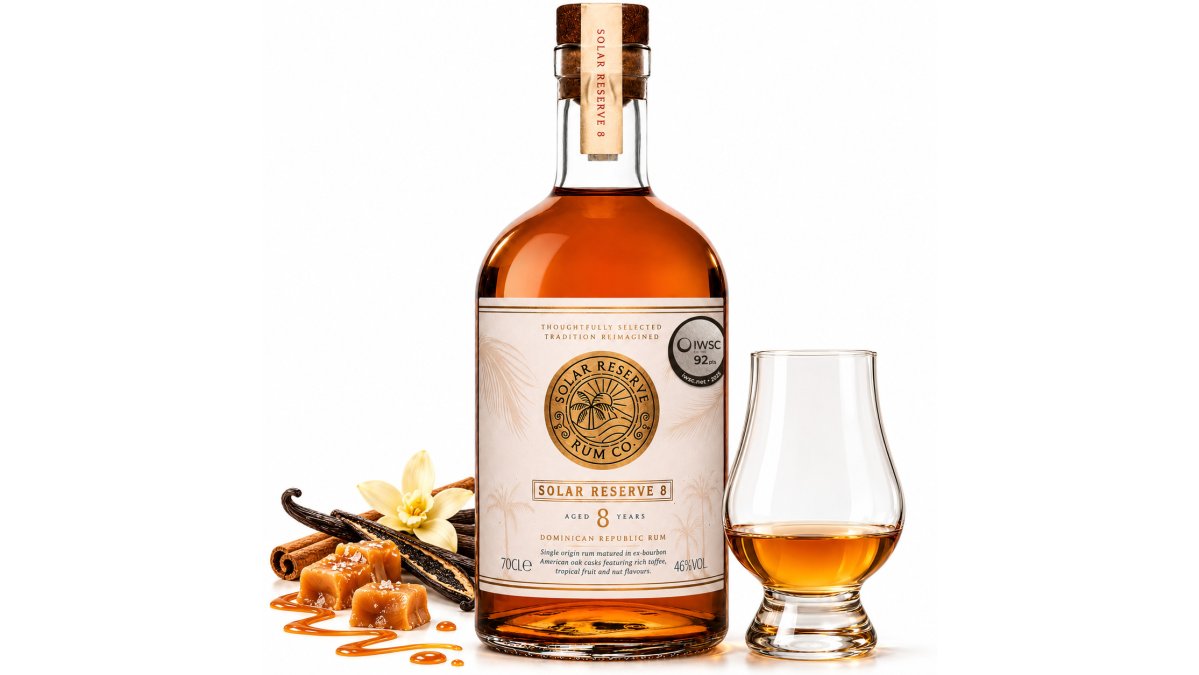
Ageing happens at origin, in full tropical heat, in once-used ex-bourbon American oak.
The nose brings sweet mango, toffee, caramel, coconut and hazelnut, with delicate baking spices and a velvety vanilla cream finish.
Bottled at 46% ABV and 70cl for £64.90, it is a sipping rum with no added sugar and no colouring. Add a few drops of water and the fruit opens up further.
3. Solar Reserve Discovery Duo: Best Sugar-Free Rum Gift Set
Solar Reserve Discovery Duo solves the hardest problem in buying rum as a gift: you rarely know what the recipient likes. The set pairs both expressions so they can decide for themselves.

Inside are Solar Reserve 55 and Solar Reserve 8, presented together at 12% off with free delivery, discount already applied.
Both bottles are additive free, made with named producers in the Dominican Republic and Jamaica, and built independently without sugar, colouring or flavouring.
At £101.00 for the pair, it undercuts buying the bottles separately.
Sugar-Free Rum for Cocktails: Daiquiris, Old Fashioneds and More
Sugar-free rum for cocktails works best when the spirit has enough structure to stand up to citrus and bitters. A thin, over-dosed rum collapses in a Daiquiri; a cask-forward one holds. The difference is not just strength but the depth of flavour that comes from ageing without additives.
Why dry rum changes the drink
When a rum contains added sugar, the cocktail recipe often compensates by reducing syrup. With a genuinely sugar-free rum, you control the sweetness yourself. That means you can dial in the balance to your taste rather than inheriting a producer's dosing.
A classic Daiquiri needs only rum, lime and a touch of syrup, so the rum is doing most of the work. Solar Reserve 55's pot still component gives it the backbone to carry that. The grassy, funky edge from the Jamaican rum survives dilution, where softer rums disappear.
Three rules we would follow
- Match strength to the drink. Higher ABV rums suit stirred cocktails like the Old Fashioned or the Manhattan, where dilution is controlled. Lower ABV rums suit long, fizzy serves where the mixer provides volume.
- Cut the syrup, not the rum. If your rum is genuinely sugar-free, you control the sweetness. Start with half the syrup a recipe calls for and adjust upward.
- Taste before you pour. A rum you would not sip neat is rarely the one to build a cocktail around. If it does not taste good on its own, mixing will not fix it.
Cocktails to try
Daiquiri, 60ml Solar Reserve 55, 25ml fresh lime juice, 10ml sugar syrup (or to taste). Shake with ice and strain.
Rum Old Fashioned, 60ml Solar Reserve 8, 5ml sugar syrup, 2 dashes Angostura bitters. Stir with ice and strain over a large cube.
Ti' Punch, 60ml Solar Reserve 55, 15ml fresh lime juice, 10ml sugar syrup. Stir in the glass. A simple, spirit-forward serve that lets the rum speak.
Drinkaware guidance on alcohol units and responsible drinking is worth a read if you are hosting, since spirit-forward cocktails add up quickly.
Conclusion: Choosing the Right Sugar-Free Premium Rum for You
The sugar-free label is only as good as the transparency behind it. Demand a named distillery, a real age statement and a stated ABV, and you will rarely be disappointed.
SolarRum exists to make that choice simple. Our range is additive free, aged in American bourbon oak casks, and bottled by Scottish cask masters, with the awards and tasting notes to match. Start with Solar Reserve 55 for cocktails, Solar Reserve 8 for sipping, or the Discovery Duo if you want both.
Get started with SolarRum and taste what Caribbean rum does without added sugar.
Frequently Asked Questions
What is the best sugar-free rum?
The best sugar-free rum depends on whether you plan to sip it or mix it. For sipping neat, an 8-year-old single-origin rum aged in ex-bourbon casks offers depth without additives. For cocktails, a versatile golden blend works well in Daiquiris and Rum Old Fashioneds. Solar Reserve 55 and Solar Reserve 8 are both made without added sugar and suit different drinking occasions.
How can you tell whether a rum has added sugar?
Check the label for terms like 'additive-free' or 'no added sugar'. Look for transparency about production methods and aging. If a rum tastes syrupy or overly sweet without any bitterness or oak character, it likely contains added sugar.
Does aged rum contain added sugar?
Not necessarily. Aging in oak barrels naturally extracts compounds like vanillin and tannins that create sweetness-like flavours without adding sugar. However, some producers add sugar after distillation to smooth out harsh notes or appeal to certain palates. Rums labelled 'additive-free' or 'no added sugar' have not had sugar introduced at any stage.
Which sugar-free rum is best for sipping?
A rum with no added sugar for sipping should have complexity from aging, not from additives. Look for age statements, single-origin provenance, and maturation in quality casks. An 8-year-old rum aged in American bourbon oak delivers natural notes of vanilla, caramel, and spice. Serve it neat or with a drop of water to open up the flavours.
Is sugar-free rum suitable for cocktails?
Yes, sugar-free rum works well in cocktails, though you may need to adjust sweeteners in the recipe. A Daiquiri made with sugar-free rum and a quality syrup will taste cleaner and let the rum's character shine. For a Rum Old Fashioned, use a small amount of demerara syrup or omit it entirely to keep the drink sugar-free.