
Last Updated: October 30, 2026
Quick Summary
To batch cocktails for a large group, multiply each ingredient by your guest count, assuming two to three drinks per person, then add water for dilution and chill the batch for at least four hours. Shaken drinks need added water at around 20-25% of total liquid volume, while stirred drinks need slightly less.
- Plan for two drinks per guest in the first hour, then one per hour after that.
- Make about 10% extra, because running out is worse than having leftovers.
- Chill the sealed batch in the fridge for at least four hours, ideally overnight.
- Use large ice blocks in the serving vessel rather than standard cubes to slow melting.
- Citrus-heavy batches are best within 24 hours, so label the container with the date.
Table of Contents
- Why Batching Works Better Than Mixing to Order
- Use a Batch Cocktail Calculator to Scale Any Recipe
- How Much Dilution to Add to Batched Cocktails
- Big-Batch Cocktail Recipes Built Around Rum
- Make-Ahead Cocktails for Parties: A Prep Timeline
- Chilling, Storage and Ice Management for a Crowd
- Garnishes, Glassware and Serving Without a Queue
- Pick Your Rum and Plan Your First Batch
- Frequently Asked Questions
Why Batching Works Better Than Mixing to Order
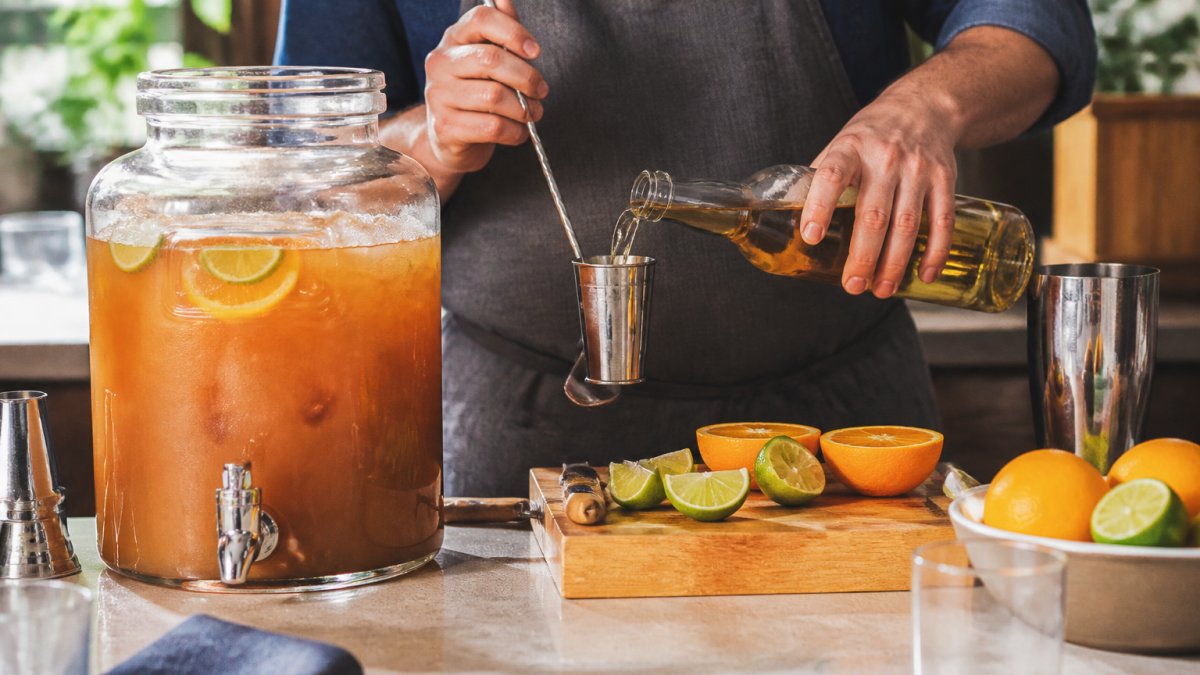
Here is the problem with mixing drinks one at a time for a crowd: you spend the whole party behind the table. This efficiency allows you to step away from the mixing glass and focus on the other essential logistics of hosting a BBQ party.
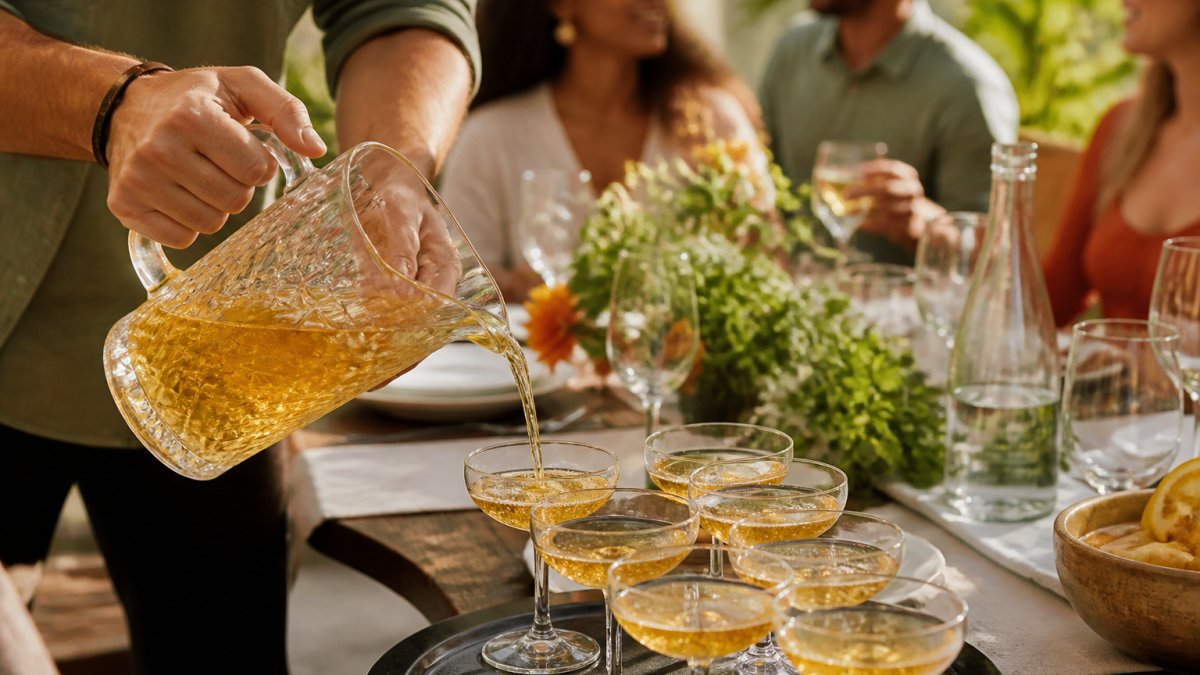
Hosts often end up shaking twelve individual Daiquiris while their guests wait. There is a better way.
The maths is simple. A jug of pre-mixed cocktail takes two minutes to build. Twelve separate drinks take twenty.
And it suits certain drinks far better than others. Difford's Guide on cocktail batching notes that stirred drinks are generally easier to scale than shaken ones, because they often contain only alcohol and sugar.
Use a Batch Cocktail Calculator to Scale Any Recipe
A batch cocktail calculator is a simple tool that multiplies a single-serve recipe by your guest count, then adjusts for dilution and serving size. You can build one in a spreadsheet in five minutes.
The Simple Scaling Formula
Every batch starts with one number: how many drinks you need.
- Step 1: Count guests, then assume two to three drinks each for a two-hour party.
- Step 2: Multiply each ingredient by that number.
- Step 3: Add water or melted ice for dilution.
- Step 4: Taste, adjust, and chill.
For example, a Daiquiri for one uses 50ml rum, 25ml lime juice and 15ml sugar syrup. For 20 guests at two drinks each, that becomes 2 litres of rum, 1 litre of lime and 600ml syrup. Add dilution, then chill.
How Many Drinks Per Guest
Plan for two drinks per guest in the first hour, then one per hour after that. A three-hour party for 20 people needs roughly 80 servings.
Always make about 10% extra. Running out is worse than having a little left over.
How Much Dilution to Add to Batched Cocktails
Dilution is the step most hosts skip, and it is the one that decides whether your batch tastes right. Batch cocktails need water added up front to mimic the melt from shaking or stirring.
As a general guide, shaken drinks benefit from added water at around 20-25% of the total liquid volume, and stirred drinks need slightly less.
But the precise figure depends on the method the drink was designed for.
A Water-to-Spirit Ratio Chart by Cocktail Type
Use this as a starting point, then taste and adjust. The percentages refer to water as a share of the total liquid volume before dilution.
| Cocktail style | Example | Added water (% of total liquid) | Notes |
|---|---|---|---|
| Shaken citrus-forward | Daiquiri, Margarita | 22-25% | Highest dilution; shaking aerates and melts heavily |
| Shaken spirit-forward | Martini-style, Manhattan-style | 18-22% | Less citrus, less melt assumed |
| Stirred spirit-forward | Old Fashioned, Negroni | 15-18% | Stirring adds less water than shaking |
| Built in glass over ice | Highball, Rum and Coke | 0-5% | Ice does the diluting at the point of service |
| Punch-style | Rum Punch | 10-15% | Often served over a large ice block, so lean lower |
A common pattern is to start at the lower end of the range, chill the batch hard, then taste. If it feels tight or hot, add water in 100ml increments until it softens. You cannot take water out, so add slowly.
Why Shaken Drinks Need More Water Than Stirred
Shaken cocktails pick up more water than stirred ones. Shaking breaks the ice and melts it rapidly, so shaken drinks pick up more water than stirred ones.
When you batch, you are pre-adding that melt. If you skip it, the drink tastes concentrated and hot. If you overdo it, the drink tastes flat and thin.
Want the exact Daiquiri build to scale? Our guide to how to craft a perfect Daiquiri walks through the ratios step by step.
Big-Batch Cocktail Recipes Built Around Rum
Rum is one of the best spirits for big-batch cocktail recipes because it carries citrus, sugar and spice without getting lost. Here are three builds that scale cleanly.
The Batched Daiquiri (shaken style)
- 2 parts golden rum
- 1 part fresh lime juice
- 0.6 parts sugar syrup
- Water at 20% of total volume
The Rum Punch (stirred style)
- 2 parts aged rum
- 1 part fresh orange juice
- 0.5 parts lime juice
- 0.5 parts sugar syrup
- A few dashes of bitters per litre
The Rum Old Fashioned (stirred style)
- 2 parts aged rum
- 0.25 parts sugar syrup
- 2 dashes bitters per serving
- Water at 15% of total volume
One tip from experience: use fresh citrus, never the bottled stuff. It is the difference between a drink that tastes alive and one that tastes flat.
If you are choosing which bottle to build around, you can browse the full Solar Reserve Rum range to pick the right style for each recipe.
Make-Ahead Cocktails for Parties: A Prep Timeline
Make-ahead cocktails for parties work best when you build them in the right order. Here is a timeline we would use for a Saturday evening event.
| When | Task | Time Needed |
|---|---|---|
| Two days before | Buy spirits, citrus and ice; make sugar syrup | 45 minutes |
| One day before | Juice citrus; build and chill the batch | 30 minutes |
| Morning of | Cut garnishes; chill glassware; buy fresh ice | 20 minutes |
| One hour before | Set up the serving station; taste the batch | 15 minutes |
Juice the citrus the day before rather than a week ahead.
Planning a fuller drinks event?
Chilling, Storage and Ice Management for a Crowd
Ice is the hidden cost of any party. Most hosts underestimate it badly, and most guides ignore the real problem: how to keep a large batch cold without turning it into a watery mess.
Plan for enough ice to chill the batch, serve over ice and top up through the evening, and buy it the morning of the event.
Large Ice Blocks vs Standard Cubes
The single best ice decision you can make for a batched cocktail is to use large ice blocks in the serving vessel rather than standard cubes.
A common pattern is to freeze water in a loaf tin or a clean plastic tub the day before, then float the block in the punch bowl or dispenser.
Standard cubes are fine for chilling the batch quickly before serving, but they are a poor choice for the serving vessel itself. They melt fast, water down the drink, and leave you with a lukewarm puddle by the second hour.
How to Chill a Batch Without Diluting It
There are three reliable methods, and the right one depends on your timeline.
- Fridge chilling (best): Store the sealed batch in the fridge for at least four hours, ideally overnight. No dilution, no fuss. This is the method to use whenever you have time.
- Ice bath (fast): Sit the sealed jug in a larger container of ice and water for 30-45 minutes. The water conducts cold far better than air. Do not add ice directly to the batch.
- Freezer (careful): A sealed batch can go in the freezer for 45-60 minutes if you set a timer. Beyond that, it will start to freeze and separate. Never leave it unattended.
Storage and Make-Ahead Limits
Store your batch in the fridge, not the freezer. Store the sealed batch in the fridge, using a clean, food-safe container.
Citrus-heavy batches are best within 24 hours. Label the container with the date and the drink name so you are not guessing later.
A Simple Ice Plan for a 20-Guest Party
| Use | Amount | When to buy |
|---|---|---|
| Chilling the batch (ice bath) | 3-4kg | Morning of |
| Serving vessel (large block) | 1-2kg block | Freeze day before |
| Guest glasses | 10-12kg | Morning of |
| Top-ups | 3-4kg | Morning of |
That is roughly 20kg in total, which matches the 1kg-per-guest rule. Buy bagged ice from a supermarket or convenience store the morning of the event, and keep it in a cool box until needed.
Garnishes, Glassware and Serving Without a Queue
The goal is a serving station that moves fast. Guests should be able to pour their own drink in under thirty seconds.
- Pre-cut citrus wheels and twists, stored covered in the fridge
- Use coupe or rocks glasses, pre-chilled on a tray
- Set out a small dish of garnishes next to the dispenser
- Keep a jug of water and a bowl of ice beside the batch
- Skip anything that needs shaking at the point of service
Glassware matters more than people think. A coupe suits a Daiquiri; a heavy rocks glass suits a Rum Old Fashioned. Pre-chill both, and the drink holds its temperature longer.
Pick Your Rum and Plan Your First Batch
The rum you choose sets the ceiling on your batch. A thin, sweetened spirit will taste thin and sweet no matter how good your ratios are.
Solar Reserve 55 blends Jamaican pot still character with Dominican Republic smoothness, aged in American bourbon oak casks with no added sugar.
For a stirred Rum Old Fashioned, Solar Reserve 8 brings eight years of tropical ageing and deep notes of toffee, mango and warm spice. It costs £59.90.
New to rum styles and stills? The Solar Rum Guide is a straight-talking guide to styles, stills and ageing to choose confidently.
Frequently Asked Questions
How do you calculate cocktail quantities for a large group?
Work on two drinks per guest for the first hour and one per hour after that, then add roughly 10 per cent as a buffer. For 30 guests over three hours, that is about 120 servings. Convert servings into millilitres using your recipe's total volume, then divide by the bottle size you are pouring from. A 70cl bottle holds 700ml, so a 90ml serve gives you seven to eight drinks per bottle. Build the sum into a batch cocktail calculator and round up to whole bottles.
Should you add water when batching cocktails?
Yes, if the drink would normally be stirred or shaken with ice. Ice melt is part of the recipe, and leaving it out makes a batch taste hot and sharp. Add chilled water to account for melt, as the drink would normally be stirred or shaken with ice. Add it before chilling so the dilution is even, and never top up a batch with ice cubes that will melt unevenly in the jug.
How far ahead can you batch cocktails, and can you include citrus juice?
Keep the batch chilled in the fridge, and add fresh citrus close to serving time. For parties, squeeze and strain citrus the day before, keep it in a sealed bottle, and combine it with the spirit base on the morning of the event. Carbonated mixers should only be added at the moment of serving.
How many cocktails should you plan per guest, and which rum suits a batch?
Plan two drinks per guest in the first hour, one per hour afterwards, and a soft option for anyone not drinking. Solar Reserve 55 at £47.90 carries caramel, toffee and vanilla notes, while Solar Reserve 8 at £59.90 brings mango, toffee and baking spice to a stirred rum Old Fashioned. Both are bottled without added sugar, so your syrup is the only sweetness in the glass.
Batching well comes down to three things: the right ratios, enough dilution, and a spirit worth pouring. Get those right and you will spend the party with your guests, not behind the table. Start with a bottle of Solar Reserve 55, build your first jug, and taste the difference a proper batch makes.
